
Before Life My Saving answers the question, “Does Renters Insurance Cover Car Break Ins,” it helps to understand the basic components of what renters insurance actually covers, because most policyholders only discover the full scope of their coverage after something goes wrong.. Renters insurance is a type of personal lines policy designed specifically to protect tenants who don’t own the property they live in, and it typically includes three core protections: personal property coverage, liability coverage, and additional living expenses. Understanding how these work together is the foundation of making smart decisions about your coverage.
Important caveat throughout this article: Insurance policies vary significantly by carrier, state, and the specific endorsements you’ve purchased. The principles described here reflect common industry practice, but your exact coverage always depends on your declarations page, endorsements, sub-limits, and the precise wording of your policy. When in doubt, call your agent or read your policy document directly.
What Does Renters Insurance Actually Cover?
Personal Property Coverage Explained
Personal property coverage is the part of your renters policy that reimburses you when your belongings are damaged, destroyed, or stolen. It applies to items like furniture, clothing, electronics, jewelry, and sporting equipment. The key — and this is what makes it directly relevant to car break-ins — is that this protection typically extends beyond your apartment walls, following your belongings into the world with you.
Most standard renters policies (filed under the ISO HO-4 form) cover your personal property against named perils, which is a defined list of covered events. Theft is almost universally included as one of those perils. So if your laptop is stolen, whether it disappears from your apartment or from your car in a parking garage, the theft peril is still triggered. The where matters less than what happened and what was taken — though, as we’ll cover shortly, the how much can vary depending on your specific policy’s off-premises provisions.
Ready to get your money back after a car break-in? [Click here to start your theft claim] and let our experts handle the hassle for you
Liability and Additional Living Expenses
Liability coverage protects you if someone is injured in your rental home or if you accidentally cause damage to another person’s property. Additional Living Expenses (ALE) kick in when your home becomes temporarily uninhabitable and you need hotel accommodations. While neither of these directly relates to a car break-in, understanding them confirms that renters insurance is a much broader safety net than most tenants realize — it’s not just a “stuff” policy.
Does Renters Insurance Cover a Car Break-In? The Real Answer
This is the question renters across the country type into Google every day, and the answer is nuanced in a way that most insurance websites fail to explain clearly. A renters insurance car break-in claim can absolutely be valid, but what gets covered and what doesn’t depends on a few critical distinctions that are worth taking the time to understand properly.
Here’s the plain: renters insurance covers your stuff, not your car. If someone smashes your car window and steals your camera equipment off the back seat, your renters policy can potentially reimburse you for the camera. But it won’t pay for the broken window — that damage to the vehicle itself is a matter for your auto insurance, specifically comprehensive coverage. If you want to understand the auto-policy side in more detail, read our guide on how much insurance may pay to fix your car after covered damage. For older drivers who want broader vehicle protection beyond basic property coverage, it also helps to compare best full coverage car insurance for seniors in 2026 before choosing a policy. This distinction is one of the most misunderstood aspects of personal property insurance, and it costs people money when they file a claim with the wrong policy.
What Items Stolen From Your Car May Be Covered
Almost any personal belonging you’d normally keep inside your home can qualify for coverage when it’s temporarily stored in your car. This includes laptops, tablets, cameras, personal clothing, headphones, and even cash — though cash is typically subject to a very low sub-limit, often around $200. The guiding principle is that the item is your personal property, not a functional component of the vehicle.
Items permanently attached to or built into your car generally don’t qualify. A factory-installed navigation screen is part of the vehicle. A professionally wired aftermarket stereo system could be interpreted as a vehicle component rather than personal property, depending on your insurer’s definitions.
One important exception to understand: items used primarily for business or work purposes often carry a significantly lower sub-limit under standard HO-4 policies. Many policies cap business property coverage at $500 when the item is off-premises — and if the laptop belongs to your employer rather than you personally, your personal renters policy may deny the claim entirely, as it’s not your property to insure. If you regularly carry expensive work equipment, ask your insurer about a business property endorsement or confirm coverage with your employer’s commercial policy.

Actual Cash Value vs. Replacement Cost: What You’ll Actually Get Back
Not all renters policies pay out the same way after a theft, and the difference can be hundreds or even thousands of dollars. Policies that pay Actual Cash Value (ACV) reimburse you for the depreciated value of the stolen item — meaning a laptop you paid $1,200 for two years ago might only return $600 because of depreciation. Policies that pay Replacement Cost Value (RCV) reimburse you for what it costs to buy a comparable new item today.
RCV policies typically cost slightly more in premiums, but for renters who carry expensive electronics, cameras, or instruments, the upgrade is almost always worth it. When comparing renters insurance quotes, asking whether coverage is ACV or RCV is one of the single most impactful questions you can ask before signing.
Does Renters Insurance Cover Theft Outside the Home?
A lot of renters are genuinely surprised to discover that their policy follows them outside their apartment. The question of whether renters insurance covers theft outside the home is answered directly inside the policy language itself — and the answer is generally yes, with important conditions and carrier-specific limits that you need to understand before assuming the full coverage amount applies.
This broader protection is sometimes called off-premises coverage, and it’s one of the most valuable — and least publicized — features of renters insurance. Whether your bag is stolen at a coffee shop, your camera is taken from a hotel room, or your bike disappears from a rack outside a gym, your personal property coverage can apply as long as the cause of loss is a covered peril like theft, and you haven’t exceeded your applicable coverage limit.
Off-Premises Coverage — How Far Does It Reach?
This is where the details really matter, and where oversimplification can mislead renters into assuming more protection than they actually have. The off-premises limit varies significantly by carrier and policy.
Some insurers do extend the full personal property coverage limit to belongings stolen away from home. However, many standard HO-4 policies apply a sub-limit for property located off-premises — commonly 10% of your personal property coverage limit (or $1,000, whichever is greater), and this cap can apply domestically as well as internationally. Separately, most policies also limit coverage to 10% for property “usually located” at another residence or kept in self-storage.
The Insurance Information Institute notes that personal property is generally covered anywhere in the world under renters insurance, but also flags that some companies limit the amount covered away from home to 10% of the personal property limit. In practice, you should never assume you have full-limit off-premises protection without reading your declarations page or confirming with your agent. The difference between 10% and full-limit coverage on a $30,000 policy is $27,000 — it’s worth the phone call.
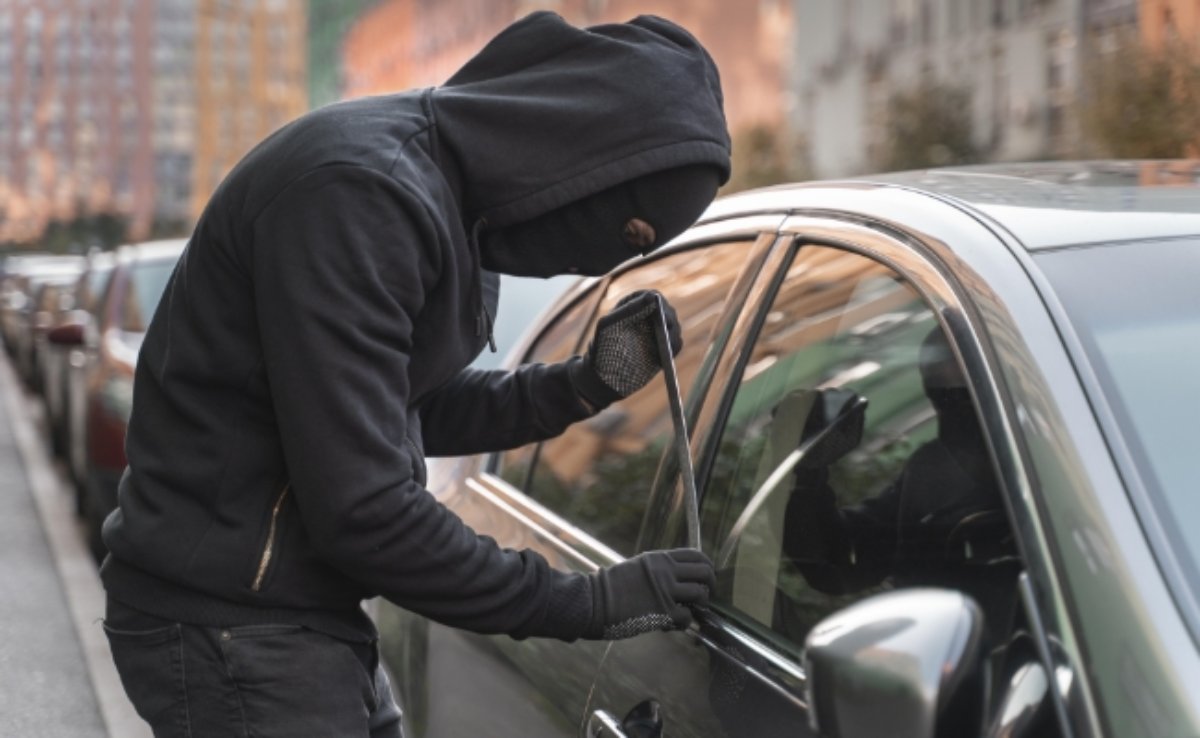
Common Scenarios: Stolen Laptop, Smashed Car Window, Gym Bag
Let’s make this concrete with three real-world situations renters commonly face.
Scenario 1 — The Stolen Work Laptop: You run into a store for five minutes and leave your laptop bag on the passenger seat. Someone smashes the window and grabs it. Your renters insurance may cover the laptop under personal property coverage — but keep in mind that if it’s a work device used primarily for your job, your policy’s business property sub-limit may cap reimbursement at $500 or less. If it’s your employer’s laptop, your personal policy likely won’t cover it at all. Your auto insurance (comprehensive) handles the broken window separately.
Scenario 2 — The Airport Baggage Theft: Your checked bag is lost or stolen during a flight. Your renters insurance personal property coverage can potentially step in, subject to your deductible, your off-premises sub-limit (if one applies), and the covered perils listed in your policy.
Scenario 3 — The Gym Bag Grab: Your bag is stolen from a gym locker room. The personal items inside — phone, headphones, clothing — may be covered under the off-premises theft provision, again subject to your policy’s specific limits and your deductible.
In all of these cases, your renters insurance can function as a portable safety net for your belongings. The key word is can — because the exact amount recoverable depends on your policy’s off-premises provisions, not just the existence of theft coverage.
What Renters Insurance Does NOT Cover After a Car Break-In
Understanding what’s excluded is just as important as knowing what’s included — and this is where many policyholders get an unpleasant surprise when they file a claim. Knowing the exclusions upfront lets you fill the gaps with the right coverage before something happens.
The single most important exclusion to understand is that renters insurance does not cover your vehicle. This cannot be overstated. If you carry only renters insurance and no comprehensive auto coverage, you will pay out-of-pocket for every piece of physical damage to your car from a break-in — the smashed window, the pried door frame, the damaged ignition. There is no grey area here; vehicles are categorically excluded from renters insurance policies.
The Car Itself Is Not Covered (That’s Auto Insurance)
Vehicle damage falls squarely under automobile insurance, not renters insurance. Comprehensive auto coverage is the correct policy for physical damage from break-ins, vandalism, or theft of the vehicle itself. If vehicle damage leaves you without transportation for a few days, it may also help to review should I get rental car insurance before you decide what backup coverage you need. If you’ve dropped comprehensive coverage on an older car to save on premiums, you’re accepting full out-of-pocket exposure for exactly this scenario. A single window replacement can run $300–$600 at a glass shop, and structural door or lock damage can cost considerably more.
Deductibles and Coverage Limits to Watch For
Even when your renters insurance does cover stolen items, two financial factors determine how much you actually receive: your deductible and your coverage limits. Your deductible is the amount you pay before insurance kicks in. If your deductible is $500 and your stolen items are worth $350, filing a claim won’t benefit you financially — and may cause your premium to rise at renewal.
High-value items like jewelry, watches, furs, and fine art are typically subject to sub-limits (often $1,000–$1,500 per category) under a standard HO-4 policy. If you regularly keep expensive items in your car, scheduling them specifically on your policy with a personal property endorsement is the only way to ensure full coverage. Always read the sub-limits table in your declarations page — it’s one of the most overlooked sections of any renters policy.
How to File a Renters Insurance Claim After a Car Break-In
Filing a renters insurance claim after a car break-in is more straightforward than most people expect, but doing it correctly makes a meaningful difference in how quickly and how much you’re reimbursed. The process rewards policyholders who document carefully and act without delay.
The first practical step is to file a police report. For theft claims, insurers commonly ask for a police report as part of the documentation process, and failing to file one can slow or weaken your claim — even if it doesn’t automatically disqualify you from coverage under every policy. It also creates an official record in the event the stolen property is later recovered.
Step-by-Step Claim Process
Step 1: File a police report promptly. Visit your local police department or use an online reporting portal if your jurisdiction offers one. Save the report number.
Step 2: Document everything. Photograph the broken window, any forced entry points, and the interior where items were stored. Write out a list of every stolen item with estimated purchase dates and values.
Step 3: Contact your renters insurance company as soon as possible. Most policies require claims to be reported promptly — check your policy for the exact language, since each carrier may define this differently. As a general rule, the sooner you report, the better. If you want to know what usually happens after reporting the loss, it also helps to understand how long a car insurance claim takes before payment is finalized.
Step 4: Submit your documentation. Provide the police report, your itemized list, photos, and any receipts, bank statements, or credit card records that support the value of your belongings.
Step 5: File a separate auto insurance claim for vehicle damage. Contact your auto insurer for the broken window, damaged locks, or any structural damage to your car.
Tips to Maximize Your Claim
Maintaining a home inventory is one of the single most effective habits for a well-supported insurance claim. Even a short video walkthrough of your belongings, saved to the cloud, gives your insurer something concrete to reference. Apps like Encircle or even a shared Google Photos album can serve this purpose. Saving purchase receipts digitally — especially for electronics and cameras — means that documentation survives even if your devices are stolen.
How Much Does Renters Insurance Cost? (And Is It Worth It?)
One of the most common reasons renters skip coverage is the assumption that it’s expensive. In reality, renters insurance is one of the most affordable personal insurance products available, and the value-to-cost ratio is genuinely difficult to beat at its price point.
According to the Insurance Information Institute (III), citing the latest NAIC data available at time of publication, the average renters insurance premium in the United States was $171 per year in 2022 — roughly $14–$15 per month. It’s worth noting that market conditions, inflation, and regional risk factors mean that current quotes will vary, and premiums in states with higher costs of living, elevated property crime rates, or significant weather exposure may run meaningfully higher than this national average.
For that price point, a typical renters policy provides $30,000 or more in personal property coverage, $100,000 in liability protection, and the off-premises theft coverage discussed throughout this article. When you consider that a single stolen laptop can cost $1,000–$2,000 to replace, the math clearly favors carrying coverage. Bundling renters insurance with your auto policy through the same insurer is one of the most reliable ways to reduce your premium on both policies simultaneously — discounts of 5–15% are common. If you are still comparing the bigger value of carrying stronger protection, it helps to understand how buying auto insurance helps protect you before choosing lower limits.

Get a Free Renters Insurance Quote Today
You’ve done the research — now take the next step and find out exactly what coverage fits your situation and what it will cost.
Whether this article confirmed what you already suspected about your current policy or revealed a gap you didn’t know existed, the right renters insurance policy gives you genuine peace of mind: knowing that your laptop, your camera, your headphones, and your other valuables are protected whether they’re sitting in your apartment or locked in your car.
Fill out the short form below and a licensed insurance advisor will contact you to:
- Walk you through the best coverage options for your specific situation
- Compare quotes from top-rated carriers
- Explain off-premises limits, deductibles, and endorsements in plain language
- Help you bundle renters and auto insurance for maximum savings
No obligation. No spam. A licensed professional will reach out at your preferred time.
Frequently Asked Questions
Does renters insurance cover a car break-in if I don’t have auto insurance?
Yes — your renters policy can still cover stolen personal belongings regardless of whether you carry auto insurance. However, without comprehensive coverage on your vehicle, you’ll pay entirely out-of-pocket for physical damage to the car itself, like a broken window or damaged door lock.
What is the off-premises theft limit on my renters insurance?
It depends on your carrier and policy. Some policies cover off-premises theft up to your full personal property limit; others cap it at 10% of that limit (or $1,000, whichever is greater), and this can apply whether you’re in the U.S. or traveling internationally. Check your declarations page or call your agent to confirm the specific limit that applies to your policy. (Fix #8 — FAQ answer now reflects the accurate, hedged language)
Does renters insurance cover theft outside the home for all types of items?
Generally yes, but several sub-limits apply. High-value categories like jewelry, watches, furs, collectibles, and musical instruments are subject to their own sub-limits under most standard HO-4 policies. Business property used primarily for work is also commonly capped at a lower limit when off-premises. Scheduled personal property endorsements are the solution for high-value or work-related items.
Will filing a car break-in claim raise my renters insurance premium?
It’s possible. Some insurers factor prior claims into premium calculations at renewal; others are more lenient for a first claim. If the stolen amount is close to your deductible, it may be worth evaluating whether filing is financially advantageous before you do so.
Does renters insurance cover a stolen car?
No. The theft of the vehicle itself falls under comprehensive auto insurance, not renters insurance. Renters insurance covers only personal belongings — it has no jurisdiction over the vehicle as a whole.
How quickly do I need to file a claim after a break-in?
Your policy will specify the timeframe using language like “promptly” or “as soon as reasonably possible.” There is no universal number of days that applies across all carriers — check your specific policy document for the claims reporting requirement, and report as soon as you can to avoid any complications.
>>> Related Guides
- Review whether insurance follows the car or the driver in California
- See whether will auto insurance cover an ATV accident
- Learn do you need car insurance in Florida

William James is a personal finance and insurance writer who focuses on auto insurance, car ownership costs, and consumer-friendly coverage guides. He specializes in breaking down complex insurance topics—such as policy requirements, claims, high-risk driver coverage, and premium pricing—into clear, practical advice for everyday drivers. His work is designed to help readers compare options, understand state-specific rules, and make more confident financial decisions. At Life My Savings, William writes research-backed content aimed at making insurance and money topics easier to understand.